
Others
A RECIPE FOR INDIGO DYE [DIY TUTORIAL]

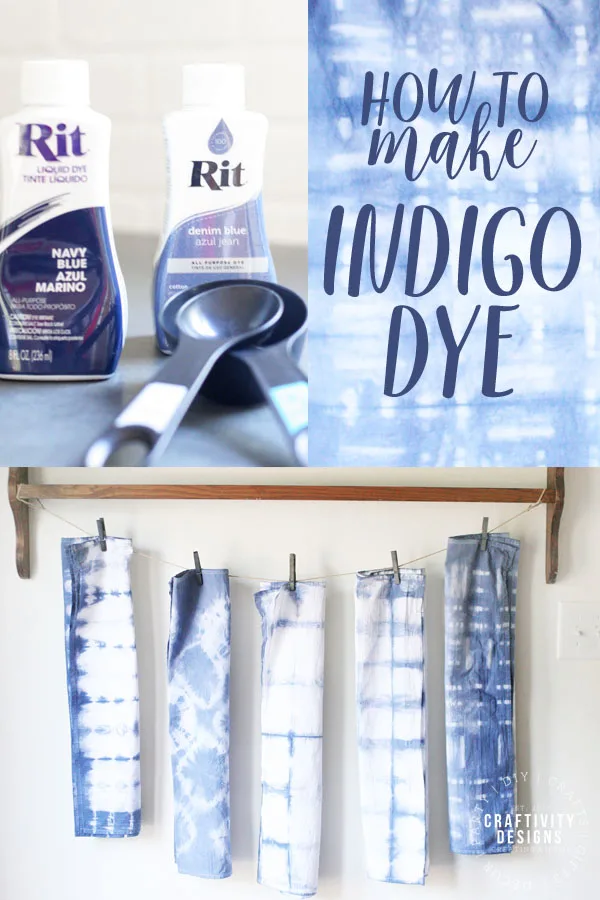
A few weeks ago my Aunty (the very creative and inspiring hand weaver, spinner and textile designer Madeleine Jude) very kindly spent the day giving me a little glimpse into the alchemy of indigo dying. Working with natural dyes is quite daunting – I’m so glad I had someone to show me rather than trying to figure it out for myself from a book. Today I’m sharing some photos of the dye making process along with the recipe we used for our indigo vat. Next time, I’ll be taking a closer look at my finished shibori dyed muslin squares and the folding techniques I used so don’t forget to pop back next week!
We based our dye vat on a recipe from Colours from Nature – A Dyer’s Handbook by Jenny Dean. The original recipe calls for ‘colour run remover’ to eliminate oxygen from the water but modern colour run removers don’t work in the same way so we used sodium hydrosulphite (hydros) instead. The quantities below made enough dye to handle 8 muslin squares, a length of cotton that had been knocking about in my stash for years and about 40g of yarn with plenty left to spare.
Before we delve into the dye recipe, here are a few interesting things about indigo!
- Indigo is the only source of true blue dye in nature but lots of different plants produce indigo.
- In order for the dye to adhere to the fibre it needs to be in a form called ‘indigo white’ (which is actually a greenish yellow colour) rather than the thick, gloopy blue liquid that you imagine. Indigo can only exist in the form of indigo white when no oxygen is present (hence the hydros). This means that when the fabric or yarn first emerges from the dye vat it will be a funny colour but as the oxygen gets to it it will transform before your eyes into deep and delicious indigo blue.
- Once you have finished dying your fabric, allow it to dry naturally for a couple of days before washing gently. After this your dye should be all set.
- You’ll need to make sure all fabric or yarn has been washed thoroughly to remove any natural oils that might interfere with the fibre’s ability to absorb the dye. You’ll also need to make sure the fabric or yarn has been soaked in water before dipping it into the dye – but squeeze it out well to make sure it doesn’t dilute the dye vat or drip into it (introducing dreaded oxygen).
Materials and equipment:
- Ideally, a large electric water heating canister (something along these lines). Failing that, a very large pan and a stove top.
- Indigo powder (Madeleine buys her’s from P&M Woolcraft which you can order online).
- Sodium Hydrosulphite
- Washing soda
- Litmus test strips
- Measuring spoons
- Kilner jar (or similar) to mix up the indigo powder
- Thermometer
- Rubber gloves
- Wooden spoon with a long handle
- Fabric or yarn to dye
- Bucket of clean, cold water ready to dunk your fabric or yarn in after it comes out of the dye vat.
- A washing line to hang it all out to dry.
Recipe:
- Dissolve 4.5 tsp washing soda in 3-6 tbsp boiling water and allow to cool slightly. Then add 6 level tsp indigo powder to this solution and mix very well into a smooth paste (this could take up to 10 minutes) adding more water if necessary. We used a Kilner jar which I would recommend as you can seal it up tightly and give it a good shake. Make sure no gritty particles remain then leave to stand until you’re ready to use it (or at least 15 minutes).
- Put enough water to make the vat into a stainless steel dye pot (we used around 12 litres) and heat to 50C/120F. This is about as hot as your hand can take. Make sure the temperature doesn’t exceed 60C/140F.
- Add approximately 25 to 30g/1oz of hydros and stir very gently. Leave for a minute or two, then very slowly and carefully stir in the indigo paste solution, making sure not to create any air bubbles as you do so. Remember, the hydros is there to remove the oxygen from the water so from this point on it’s all about not agitating the liquid or letting anything drip into it that could re-introduce oxygen and stop the dye working.
- Put the lid on the pot and, keeping the temperature constant, leave the vat to stand for 30-45 minutes or until the liquid below the surface has changed from blue to greenish yellow in colour. (The surface may still appear blue because it is in contact with the oxygen). If after 45 minutes the liquid still appears blue, add a little more hydros and leave for a further 5 – 10 minutes. We added an additional 3 tsp of hydros before the dye was ready, using litmus test strips to check when the dye was sufficiently alkali (it should be somewhere between 9 and 10). You can immediately tell once the dye is ready as it suddenly clings to the wooden spoon, coating it in thick, deep colour (and ruining it forever).
- Gently add the wetted yarn or fabric, remembering to squeeze out any excess water first. Do not put more material into the vat than will lie easily below the surface, as any sections above the surface will become blotchy. Each vat will be different and require a different amount of time – we found that 10 seconds was perfect but some recipes suggest submerging the fibres for up to 20 minutes! I recommend starting with a shorter dip and re-dipping if necessary.
- Remove the materials very gently, making sure they do not drip into the vat, then immerse them in a bucket of cold water. This is particularly important if there are any grainy particles of indigo dye powder still undissolved as these can cause blotches in your finished fabric but the bucket of water should lift them off before they have the chance to do any damage.
I hope you enjoyed today’s post! Indigo dying feels really ritualistic and special – definitely not something I’ll be doing every weekend. I liked how it took all of my concentration and nearly the whole day to make and handle the dye – dipping the fabric was the easy part! I’m really pleased that I chose muslin squares to dye as not only will I use them so often with the new bambino but it gave me a chance to try out a few different shibori techniques whilst recycling fabric I already own. I’m looking forward to showing off the finished muslins next time!
Do you use indigo dye? I would love to see your work – leave me a comment!


Over the last few weeks I’ve been working my way through Sara Tasker’s new e-course ‘Bloom & Grow‘ (you may already be familiar with Sara’s stunning Instagram account and blog Me & Orla). I signed up because Instagram had been leaving me feeling kind of flat for a while and I just felt left behind now that everyone seems to have found their style on this platform and are creating (what seems like) a never ending stream of imaginative and beautiful photos day in, day out. I consider myself pretty creative but when it comes to taking photos for Instagram, I just can’t seem to make the magic happen (I’m like that guy from the Lego Movie ‘Just tell me what to do, and how to do it’). I felt like my account didn’t really paint a picture of me, my life or my work… which is kind of the opposite of what I’m aiming for.
The course is about harnessing the power of flowers to create photos that are captivating, surprising, delighting, thought provoking and above all creative. I’m taking my time absorbing all the course materials and am slowly starting to put the things I’m learning into practice. Sara’s lessons are really helping me figure out the kind of photos I want to take and how to get there – you know how the best teachers don’t just tell you what to do but gently guide you so that you figure out the answer yourself and learn a whole load in the process? Yep, it’s like that and I wouldn’t hesitate to recommend it to anyone who feels adrift on Instagram.
This is a round about way of explaining that if you’re wondering what a melting peony ice cream has to do with crafts, the answer is that it’s another type of creativity that I’m dipping my toe into. Jumping in with both feet in fact. These are the kinds of images I want to create and I’m really looking forward to sharing that journey here as well as on Instagram.
If you would like to follow along on Instagram you’ll find me at @chloemullaney. Don’t forget to leave your Instagram handle in the comments so I can come and find you too!
You can see what my other classmates and I have been up to (and share your own floral inspired photos) with the hashtag #bloomandgrow. I’m lucky enough to be taking the course with some truly fantastic photographers and I’m so happy to be a part of this community. I’ll be back soon with a few inspiring accounts for you to follow!
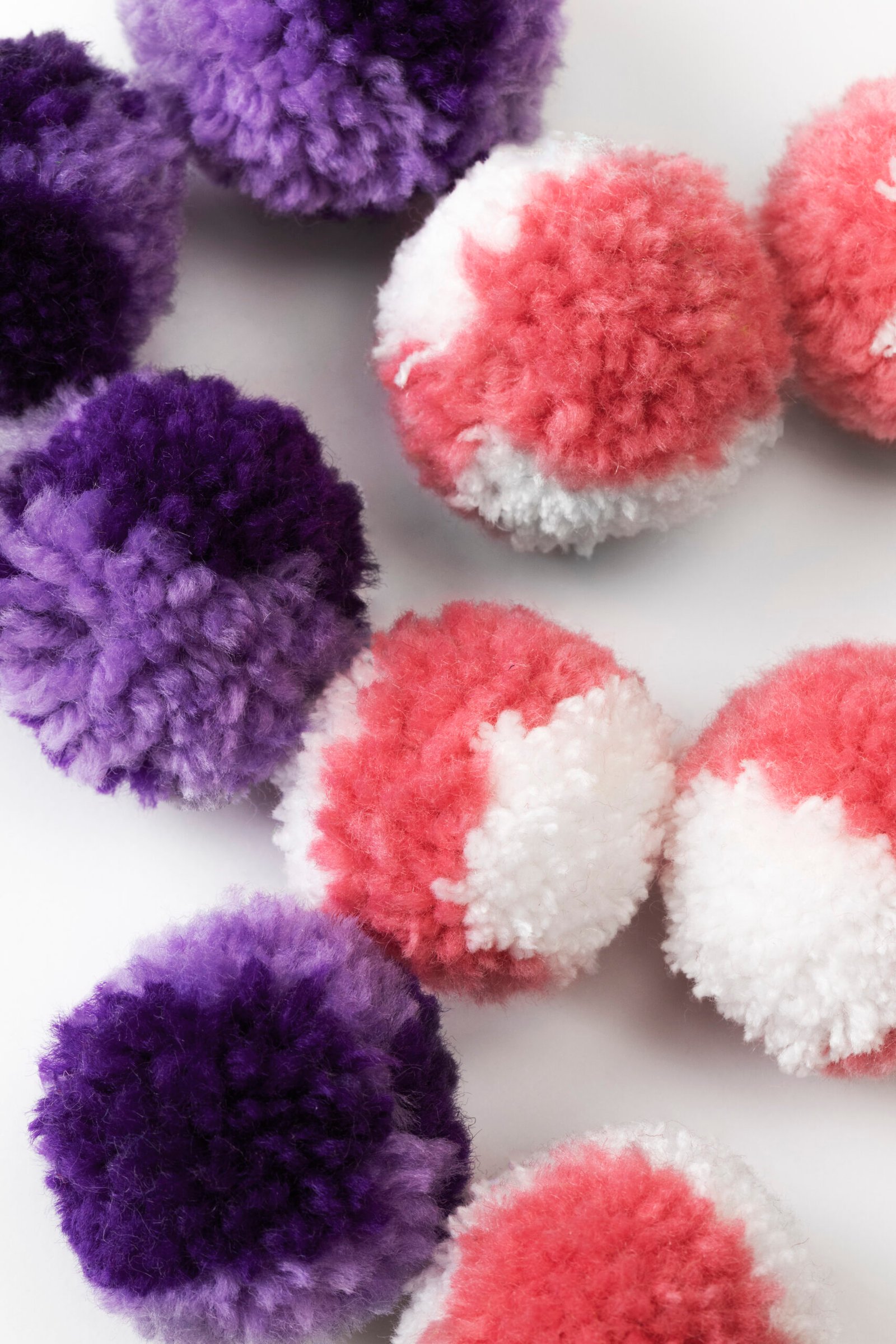
I made these fluffy pom poms recently for an upcoming DIY project and was so pleased with them I thought they deserved a tutorial in their own right…
They’re inspired by this tutorial by Honestly WTF and use pure wool roving rather than yarn for a super fluffy texture. I combined two colours by separating out the fibres and layering them up which creates an awesome marble effect.
These pom poms are super quick and easy to make! String them onto a garland, use them to finish zips on pouches and washbags, dangle a bunch of them from a door handle or make a wall hanging! The most important step is the very last one where you’ll trim your way from a big ball of fluff into a neat little pom pom – I made my first ever video to help demonstrate the process, let me know what you think!
You will need…
Wool roving – two colours
Clover pom-pom maker
Strong thread
Sharp scissors
Step 1: Cut two strips of roving (one of each colour) each approximately 8 inches long. Taking the first colour, pull off a strip lengthwise – tease the fibres apart and lay the strip flat in front of you. Do this a few more times with this colour and then switch to the second colour. Keep going until you have a little stack of alternating colours. Carefully and slowly pull the stack apart down the middle so you now have two layered piles of roving.
Step 2: To make your pom pom, take one stack of fibre and wrap it around one half of the pom pom maker, just like you would if you were making it with yarn. Repeat on the other side then close the pom pom maker.
Step 3: Take your scissors and carefully snip around the outside (be really careful not to snip through your finger…like I did).
Step 4: Cut a length of strong thread and wrap it around the middle of the pom pom before tying securely. Trim the long thread ends then carefully pull apart the pom pom maker, releasing your ball of fluff!
Step 5: Your pom pom will look pretty wild and hairy. Take a sharp pair of scissors and trim it down – making sure to keep the shape even. The more you trim, the more dense (and better!) your finished pom pom will look.
Here’s a quick video to give you an idea of how much to trim…
And there you have it! A quick and easy way to make perfect pom poms. These particular ones are destined for a fairly large scale project I’m gearing up for – don’t forget to hit follow if you would like to see the end result!

This DIY wrapping paper couldn’t be simpler and is perfect for some relaxed weekend crafting before the final Christmas countdown…
I bought my printing block from The Arty Crafty Place – they have so many gorgeous traditional and contemporary designs to choose from, all handmade in India! You could also try using a rubber stamp or even carve your own printing block from a swede (more robust than the traditional potato apparently!)
I find the process of block printing so therapeutic and am definitely going to treat myself to some printing ink in the new year but I wanted to keep this project as frugal as possible so busted out the kids poster paint. I actually quite like the chalky, matt finish it gives! I was worried it might be quite flakey once dried but I’m happy to report that my gifts are wrapped and holding up well.
You will need…
Brown paper (beware of the super cheap roll – it’s worth paying a tiny bit more to get better quality paper. Mine is a 7 metre from WHSmith and does the job nicely)
Luggage labels
Foam mat
Plate or paint palette
Sponge
Printing block
Step 1: Squirt a bit of paint onto your palette, dunk your sponge in and dab it about to spread the paint and remove the excess. Apply the paint to the printing block in a dabbing motion, making sure it’s completely covered.
Step 2: Manoeuvre your paper so that the foam mat is underneath and place your printing block onto the paper, painty side down. Press down carefully before lifting the printing block away (it helps to hold down the paper with your other hand for this bit).
That’s pretty much all there is to it. I recommend practicing on a scrap bit of paper to get a feel for how much paint to use and also how you want the pattern to repeat. Baring in mind you’ve got a lot of surface area to cover it’s a good idea to space the prints out a little! I like to offset my prints (a bit like building bricks) but you could stack them up vertically or turn the block upside down on every other row to make the overall print less directional.
You can repeat the above process using luggage labels for the gift tags – I kept everything black as it felt somehow more ‘printy’ but you could try a contrasting colour or introduce a different shaped printing block.
My top tip for the slickest Christmas wrapping is double sided tape! Make sure there are no raw edges of paper on display by folding them over twice, then invisibly seal from the inside with the tape for a nice, crisp finish (can you tell I’m a sewer at heart?).
Have a very Merry Christmas!
-

 News2 months ago
FEATURED IN CREATIVITY MAGAZINE
-

 Blog1 month ago
Discovering Eporer: The Ultimate Guide to a Revolutionary Blogging Platform
-

 News2 months ago
Fascisterne in Focus: The Role of Media in Shaping Public Perception
-

 Finance2 months ago
Crypto30x.com Ocean: Revolutionizing the Cryptocurrency Trading Experience
-
 Others2 months ago
HOW TO MAKE: A HEATED EYE MASK [DIY TUTORIAL]
-

 Blog2 months ago
The Evolution of Laaster: How This Tradition Has Changed Over Time
-

 Technology2 months ago
Kibard – Exploring the Brand, Design Philosophy & Modern Appeal
-

 Lifestyle2 months ago
Lufanest: Ultimate Platform for Smart Home and Lifestyle Solutions